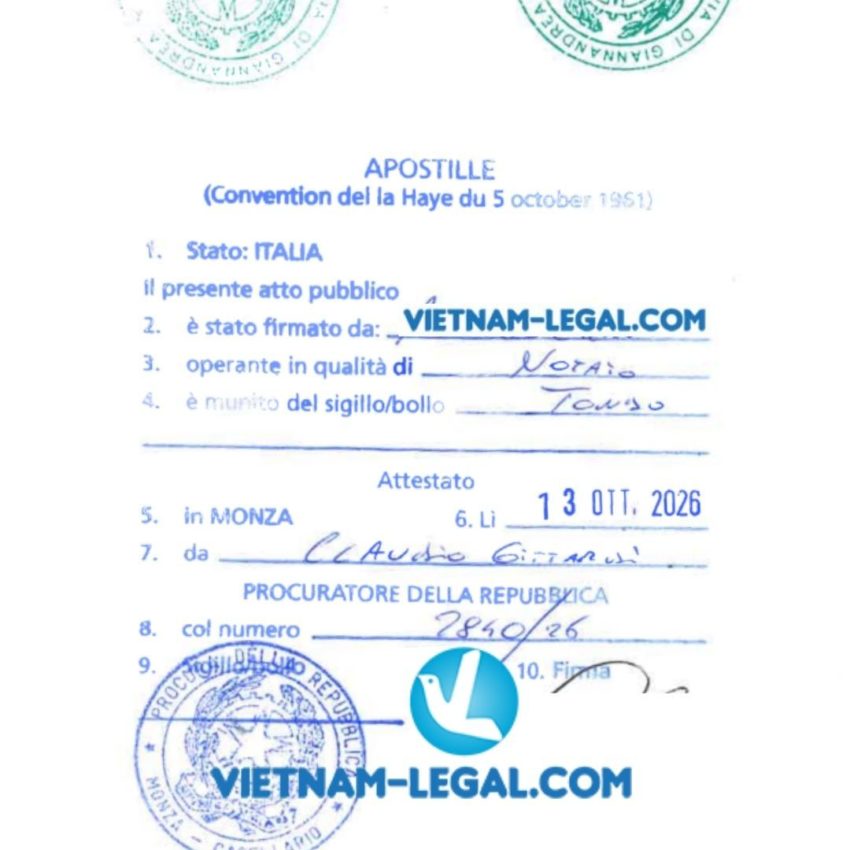
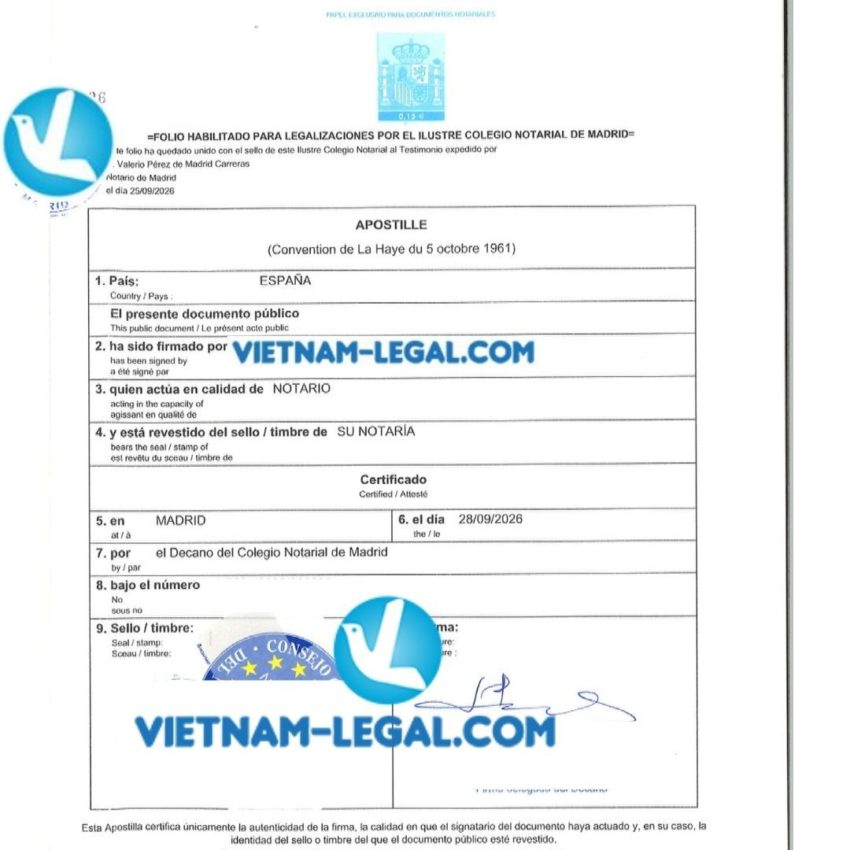
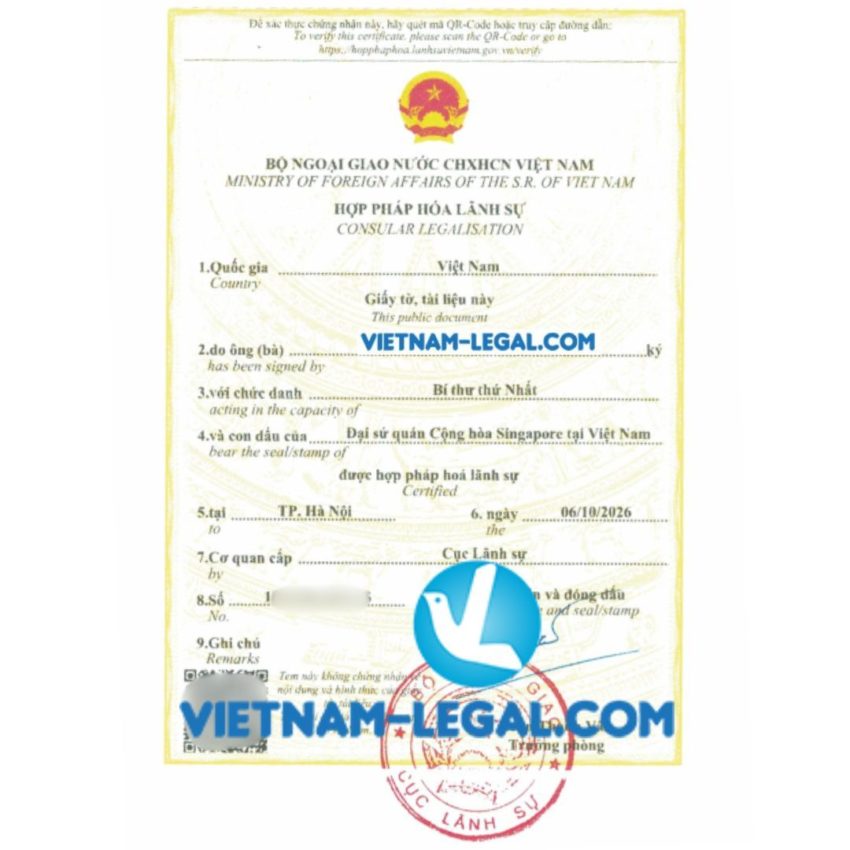
Apostille for Vietnamese documents
From September 11, 2026, Vietnam officially implements the Hague Convention of October 5, 1961, on the abolition of the requirement of legalization for foreign public documents (Apostille Convention).

APOSTILLE VIETNAM 2026 – VIETNAM APOSTILLE CERTIFICATION
Starting from September 11, 2026, Vietnam officially implements the Hague Convention of October 5, 1961, on the abolition of legalization for foreign public documents (Apostille Convention).
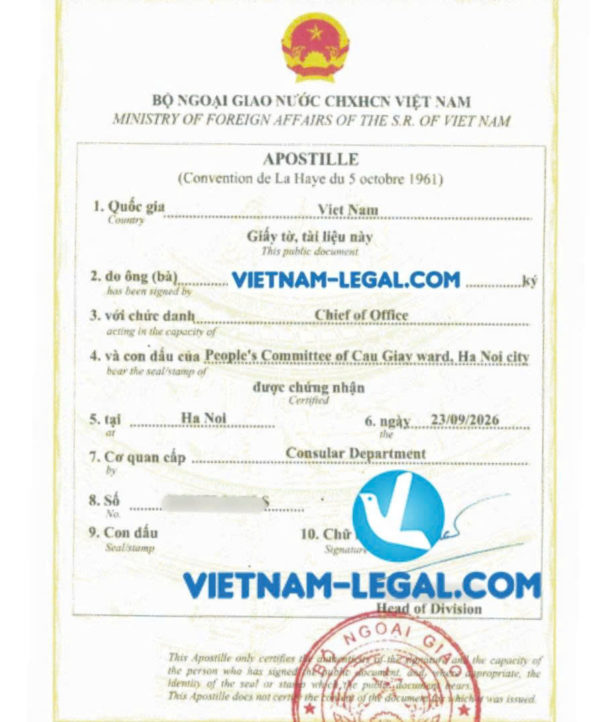
This is an important change for individuals, businesses, and organizations that need to use documents issued in Vietnam abroad.
For public documents covered by the Convention and used in countries that have a relationship applying the Convention with Vietnam, the Apostille procedure can replace the previous consular certification and legalization process.
However, Vietnam joining the Apostille Convention doesn't mean that all Vietnamese documents only need an Apostille, nor does it mean that all member countries of the Convention automatically have a relationship to apply the Convention with Vietnam.
Determining the correct procedure depends on:
Type of document → issuing authority → document format → country of use → purpose of use → relationship of Convention application between countries.
Vietnamese documents going abroad: Apostille or consular legalization?
|
Case |
Procedure |
|
Countries that apply Apostille with Vietnam |
Apostille |
|
Germany, Austria, Czech Republic |
Consular certification + consular legalization |
|
Philippines and some special cases with specific requirements |
You need to check the actual requirements before proceeding |
|
Countries that have not applied the Convention with Vietnam |
Consular legalization according to current regulations |
Note: Determining the procedure is not just based on whether the country is a member of the Apostille Convention, but also on the application relationship between Vietnam and that country, the type of document, and the requirements of the receiving authority.
Legalization.vn provides consulting services, checking, and support for Apostille, consular certification, consular legalization, and related procedures for Vietnamese and foreign documents.
With many years of experience handling international documents, we prioritize checking the proper procedures before taking action, minimizing situations where clients make mistakes, incur additional costs, or have to redo their documents.
WHAT IS AN APOSTILLE?
An Apostille is a certification under the 1961 Hague Convention, issued by the competent authority of the country where the public document was issued.
An Apostille confirms the origin of the public document, including:
- The authenticity of the signature;
- The title of the signer;
- The authority of the signer;
- Any seals or stamps on the document, if applicable.
An Apostille does not certify the content of the document.
For example, when a Vietnamese diploma is issued an Apostille, the Apostille confirms aspects related to the signature, title, and seal of the authorized person or agency on the diploma; it does not mean that the Apostille certifies the entire academic content or professional value of the diploma.
The receiving authority abroad may still require:
- A translation;
- A translation into the language of the receiving country;
- The original or a certified copy as required;
- Additional verification;
- Supplementary documents;
- Or other conditions according to the laws of the receiving country.
So, having an Apostille doesn’t automatically mean that every foreign authority must accept every document for every use.
WHAT DOES APOSTILLE IN VIETNAM MEAN?
Before Vietnam implemented the Apostille Convention, a Vietnamese document used in many countries often had to go through the consular certification process in Vietnam and then be legalized at the diplomatic mission of the country where the document would be used.
For cases within the scope of the Apostille Convention, the process is significantly simplified.
Instead of doing:
Vietnamese document → Consular certification → Embassy/Consulate of the country of use (Consular legalization).
It can be switched to:
Vietnamese document → Apostille at the competent authority in Vietnam → use in a country that applies the Convention.
However, this is the principle of the Convention, and the actual process for each case still needs to check the requirements of the country and the receiving authority.
APOSTILLE AND CONSULAR LEGALIZATION: WHAT'S THE DIFFERENCE?
This is a question we get asked very often.
|
Case |
Procedure to Consider |
|
Vietnamese documents used in a country that is a party to the Convention with Vietnam |
Apostille |
|
Vietnamese documents used in a country that is not a party to the Convention with Vietnam |
Consular authentication / consular legalization |
|
Foreign documents within the Convention’s scope, with a relationship applying to Vietnam |
Apostille in the issuing country |
|
Foreign documents not within the Convention’s scope or not having a relationship with Vietnam |
Consular legalization |
|
There is a treaty or special regulation on certification exemption |
Check specific regulations |
Therefore:
You shouldn’t just ask, “Is this country an Apostille member?”
The question to ask is:
“Where was this document issued, where will it be used, what type of document is it, and do the two countries have a relationship under the Apostille Convention?”
This is also why Legalization.vn always recommends checking the documents before customers start the procedure.
WHICH VIETNAMESE DOCUMENTS CAN BE APOSTILLED?
Not all documents fall under the Apostille Convention. Some cases to pay special attention to include:
Documents issued by diplomatic or consular officials
Documents issued by diplomatic or consular officials in the course of performing their diplomatic or consular functions are not covered by the usual application of the Convention.
Certain administrative documents directly related to commercial or customs activities
The Apostille Convention makes exceptions for some types of administrative documents directly related to commercial or customs activities.
Therefore, for commercial, import-export, or customs files, businesses need to check separately before determining the certification method.
Foreign documents are not Vietnamese documents.
Vietnamese authorities do not issue Apostilles for documents issued by foreign authorities.
Foreign documents that want to be used in Vietnam need to be considered: either Apostille in the issuing country or consular legalization, depending on the case.
CASES THAT MAY BE REFUSED AN APOSTILLE
A document belonging to the group of public documents does not automatically mean it will be granted an Apostille.
The documents could have issues if:
- Papers are erased or altered improperly;
- There are signs of forgery;
- The signature is not authentic;
- The seal is not authentic;
- The title or authority of the signer is inappropriate;
- Information does not match the data/templates stored at the competent authority;
- The documents have been revoked, canceled, or declared invalid;
- The documents are identified as illegally issued;
- The documents fall under cases not allowed to be taken abroad according to regulations;
- The files are not fully supplemented within the required time;
- Electronic documents or digital signatures do not meet the required conditions.
Therefore, for important or urgent documents, checking them before submission can help avoid having to go back and redo paperwork.
WHICH AGENCY ISSUES APOSTILLE IN VIETNAM?
According to current regulations, Apostille certification in Vietnam is handled by the competent authorities of Vietnam under Decree 293/2026/ND-CP, which are:
- Consular Department – Ministry of Foreign Affairs
- Department of Foreign Affairs of Ho Chi Minh City
Leglalization.vn is not an Apostille-issuing agency.
We provide consultancy services and support clients in completing the procedure.
Our role is: Checking documents → determining the procedure → guiding/preparing the dossier → assisting with the procedure → receiving and handing over the result.
Official Apostille certification must always be issued by the competent state authority.
IS AN APOSTILLE THE SAME AS NOTARIZATION?
No.
Notarization and Apostille are two completely different procedures.
Notarization involves a notary certifying something according to the law on notarization.
An Apostille confirms the origin of a document through the signature, title/authority, and stamp/seal on the document.
A file may need notarization before doing an Apostille, but not always.
So, you shouldn’t automatically notarize all documents before checking the requirements.
DOES AN APOSTILLE TOTALLY REPLACE CONSULAR LEGALIZATION?
No.
Starting from September 11, 2026, Vietnam will adopt the Apostille Convention, but consular legalization will still exist.
The Apostille procedure and the consular certification/legalization procedure can coexist because:
- Not all countries have agreements applying the Convention with Vietnam;
- Not all types of documents fall under the scope of the Convention;
- Some documents are exceptions;
- Certain relations between countries may be governed by other regulations or international treaties.
So, the right question isn’t:
"Will there still be consular legalization from 2026?"
but rather: “Does my specific file fall under the Apostille mechanism or do I still need to get it notarized/consularized?”
CAN VIETNAM APOSTILLE DOCUMENTS TO BE USED IN ALL MEMBER COUNTRIES?
Not really.
This is one of the most confusing points since Vietnam started implementing the Convention.
A country may be a member of the Apostille Convention, but whether the Convention applies between that country and Vietnam still needs to be checked separately.
The Convention mechanism sets rules about objections to new member countries joining. So, you can’t just take the list of all member countries and conclude that:
“Vietnam can Apostille for all countries on this list.”
In particular, the specific status of the relationship between Vietnam and each country needs to be checked based on the latest information at the time of handling the case.
This is one of the most important reasons why customers should check their documents before proceeding.
CAN VIETNAMESE DOCUMENTS WITH AN APOSTILLE BE USED IMMEDIATELY ABROAD?
An apostille allows documents covered by the Convention to skip the consular legalization process in the receiving country under the Convention.
However, an apostille does not replace the content requirements of the receiving agency.
For example, the receiving agency may still require:
- Translation into the local language;
- Certified translation;
- The original document;
- A copy;
- Documents within a certain validity period;
- Additional confirmation;
- Specialised records.
So, before getting an Apostille, we usually recommend that clients let us know which agency will receive the documents and what the documents will be used for.
This is especially important for:
- Studying abroad;
- Immigration;
- Marriage;
- Job applications;
- Licenses;
- Visa applications;
- Starting a business;
- Investing;
- Commercial transactions;
- Court records.
APOSTILLE SERVICE FOR VIETNAMESE DOCUMENTS BY HOPPHAPHOALANHSU.VN
Legalization.vn has many years of experience in advising and assisting with consular certification and legalization of Vietnamese and international documents.
With Apostille, we don’t just take documents for certification—we focus on an even more important step:
CONFIRMING THE RIGHT PROCEDURE BEFORE PROCEEDING
Customers send us:
- Scans/photos of documents
- The country where they will be used
- The purpose of use
- Any requirements from the receiving authority, if available
We check:
- Whether the documents fall under the scope of Apostille;
- Whether notarization/authentication is needed beforehand;
- Whether confirmation from another authority is required;
- Whether the documents can be Apostilled directly or need prior processing;
- Whether the country using them has a treaty relationship with Vietnam;
- Whether there are any special requirements from the receiving agency.
After that, we determine:
Apostille / Consular Certification / Consular Legalization / Other procedures.
SERVICE PROCESS
Step 1 – Receive Documents
The customer sends scanned/photos of documents and information about where they will be used.
Step 2 – Check
We check the type of document, issuing authority, format, signature, seal, and related conditions.
Step 3 – Determine Procedure
Advise the customer on the appropriate procedure:
Apostille or certification/consular legalization.
Step 4 – Fees and Time
The customer is informed in advance about:
- Service fees;
- State charges, if any;
- Translation/notarization costs if needed;
- Shipping costs, if any;
- Estimated time.
Step 5 – Implementation
Legalization.vn supports customers in carrying out the steps within the agreed service scope.
Step 6 – Check and Handover
The results are checked before being handed over or sent to the address requested by the customer.
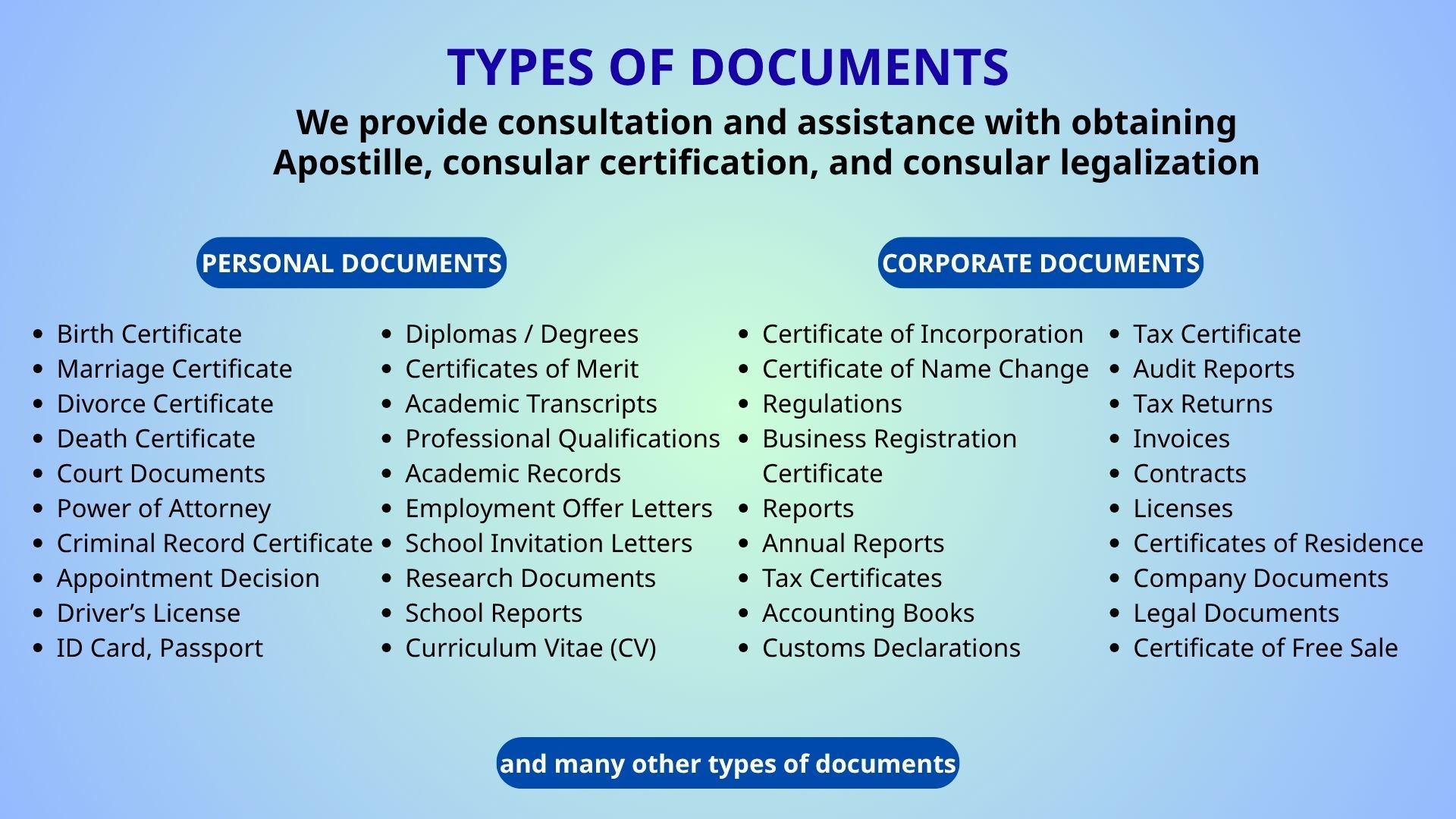
TYPES OF APOSTILLE DOCUMENTS WE USUALLY SUPPORT
WHY SHOULD YOU CHECK DOCUMENTS BEFORE GETTING AN APOSTILLE?
Over many years of handling international documents, we've noticed that the hardest part isn't always just "getting a stamp."
The real challenge usually lies in figuring out the right process from the start.
A file can run into issues like:
- Wrong type of documents;
- Incorrect copy format;
- Missing certification;
- Signature/stamp not suitable;
- Steps done in the wrong order;
- Thought it could get an Apostille, but actually needs consular legalization;
- Apostille done correctly but still doesn't meet the receiving agency's requirements;
- Translation doesn't meet requirements;
- Document completed but needs to be redone.
So, instead of:
"Do first – get rejected – figure out how to fix it later"
we recommend:
"Check first – identify the correct procedure – get it done right the first time."
This is also the main value of the consulting and international document support service at Legalization.vn.